

A Different Approach to:
Uterine Artery Embolization (UAE)
Pressure-Enabled Delivery for Uterine Artery Embolization (PED-UAE) utilizes TriNav to deliver embolic particles by augmenting pressure and maintaining forward flow for effective fibroid embolization.1-3 This approach may help direct flow to the target fibroids, while minimizing embolization to the myometrium, through pressure and flow modulation.
Baseline vs. 6-month followup MRI Comparison
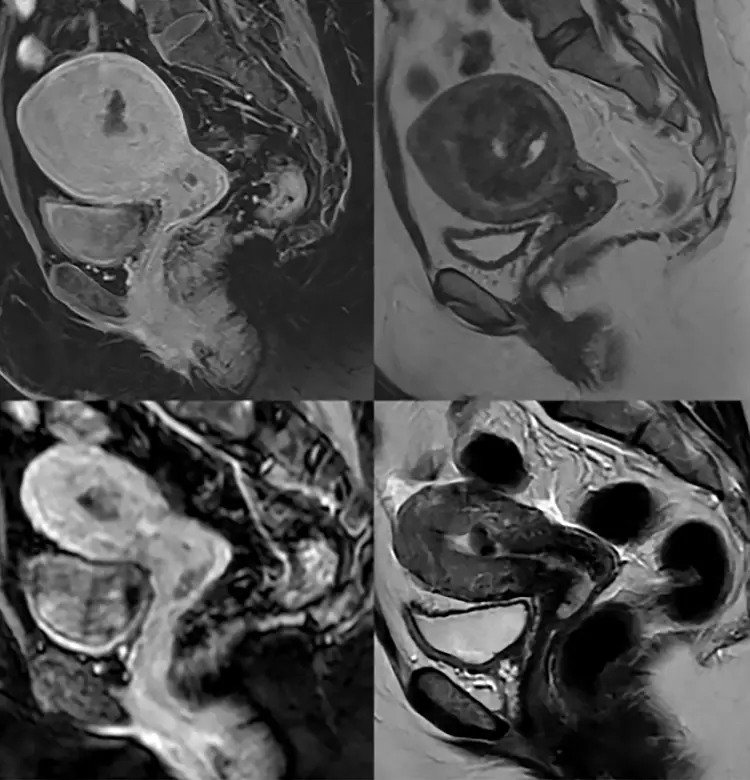
Baseline
6-Month Follow-Up
98% volume reduction at 6 months (787 mL to 18 mL)
Case example and imaging provided with permission by Dr. Francis Kang, Robert Wood Johnson University Hospital
Why It Matters
Emerging data** shows PED-UAE with the TriNav® Infusion System may help clinicians address therapeutic delivery challenges.
100% technical success
with no device-related complications in procedures with TriNav.4
10% reduced fluoroscopy time
with TriNav – 19.5 mins vs. 20.1-21.9 mins with traditional microcatheters in published literature.4
Up to 89% fibroid volume reduction
in a subset of patients with TriNav compared with 42–58% in prior literature with traditional microcatheters.4
Decreased VAS Scores
The Heavy Menstrual Bleeding VAS Score, Mean Pain VAS Score, and Composite VAS score all decreased from pre-procedure at 1-month and 6-months post-procedure** using TriNav.4
|
|
Pre-Procedure
|
1 Month Post-Procedure
|
6 Months Post-Procedure
|
|---|---|---|---|
|
Heavy Menstrual Bleeding VAS Score
|
6.6
|
2.6 (p=0.003)
|
2.1 (p=0.008)
|
|
Mean Pain VAS Score for Dysmenorrhea
|
5.4
|
3.0 (p=0.04)
|
1.5 (p=0.006)
|
|
Composite VAS Score
|
7.5
|
4.1 (p=0.001)
|
2.8 (p=0.001)
|
*Visual Analog Scale from 1 to 10
**Study Details: Retrospective, single-center study across 6 interventional radiologists with varying levels of experience, n=23 with a subset of patients analyzed for volume reduction. Study is ongoing.

Contact a representative to see how TriNav can fit seamlessly into your workflow.
Important Safety Instructions
Indications For Use
TriNav Infusion Systems are intended for use in angiographic procedures. They deliver radiopaque media and therapeutic agents to selected sites in the peripheral vascular system.
Contraindications
TriNav Infusion Systems are not intended for use in the vasculature of the central nervous system (including the neurovasculature) or central circulatory system (including the coronary vasculature).
Rx Only
For the safe and proper use of TriNav Infusion Systems, refer to the individual Instructions for Use.
References
- Xu Z, Jernigan S, Kleinstreuer C, Buckner GD. Solid Tumor Embolotherapy in Hepatic Arteries with an Anti-reflux Catheter System. Ann Biomed Eng 2016;44:1036–1046
- Durham ED, Jaroch DB. An Anti-Reflux Catheter as a Pressure-Directed Delivery Device: A Computational Model and Empirical Results. J Vasc Interv Radiol 2015;26:e33–e103
- Titano JJ, Fischman AM, Cherian A, Tully M, Stein LL, Jacobs L, et al. End-hole Versus Microvalve Infusion Catheters in Patients Undergoing Drug-Eluting Microspheres-TACE for Solitary Hepatocellular Carcinoma Tumors: A Retrospective Analysis. Cardiovasc Intervent Radiol 2019;42:560–568
- Kang, F. Novel Approaches to Uterine Artery Embolization: A Clinical Assessment of Safety and Efficacy Using a PEDD Device. Abstract submitted for presentation at: Society of Interventional Radiology Annual Meeting; April 2026; Toronto, ON. Unpublished data