
Understanding the Challenge
Overcoming Obstacles That Impede Therapy Delivery
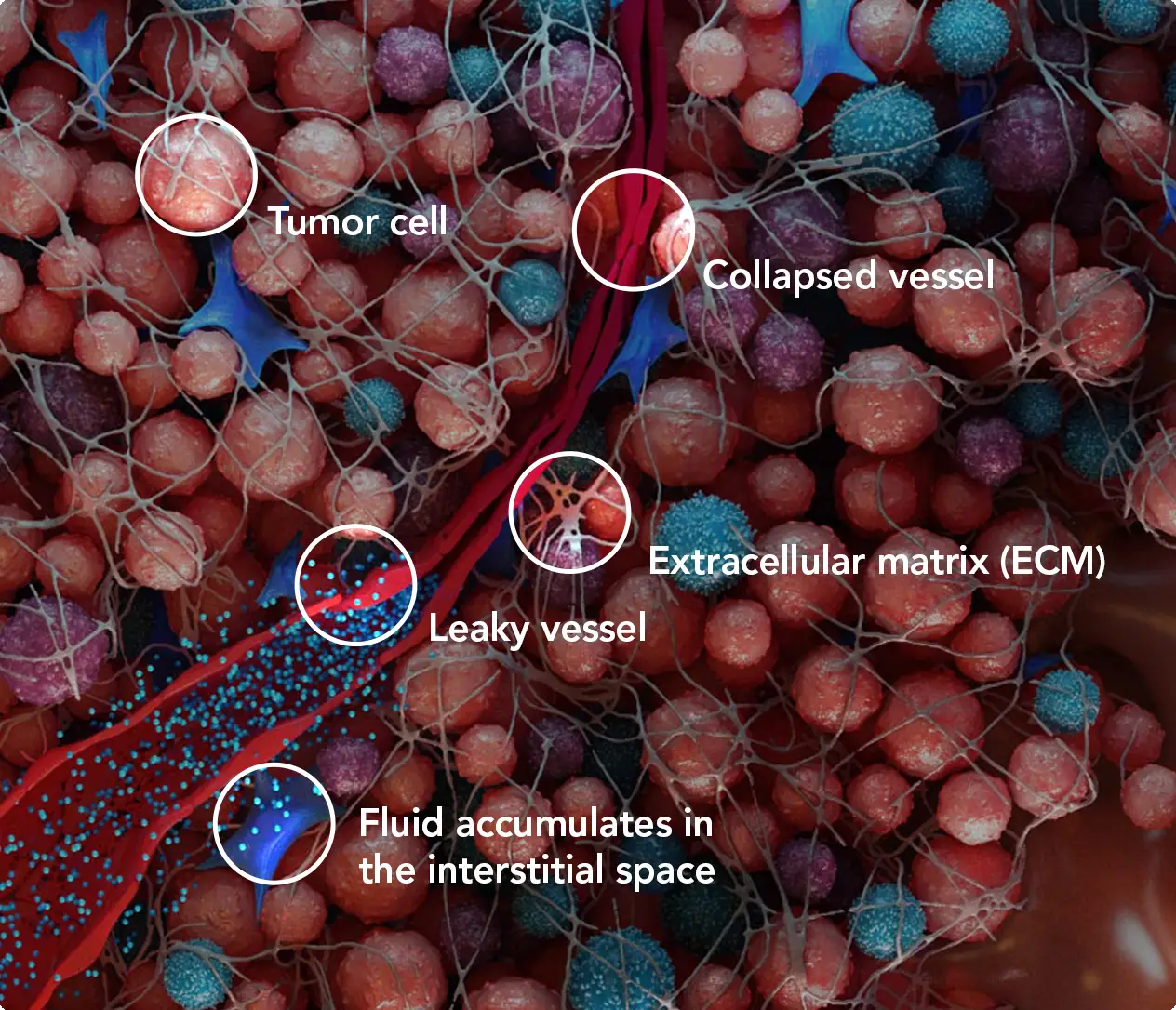
High intratumoral pressure (ITP) is a significant barrier to treatment of solid tumors in the liver.1-9 Specifically, ITP can prevent therapy from penetrating solid tumors and reaching high-pressure regions within the tumor.10
Why tumors develop high ITP
ITP is the high pressure within a solid tumor caused by rapid cell proliferation, abnormal blood vessels, and a dysfunctional lymphatic system.
- Abnormal vasculature — Solid stress compresses blood vessels, which may reduce or halt blood flow to parts of the tumor.10
- Rapid cell growth — Tumor blood vessels are immature, leaky and disorganized, causing high interstitial pressure inside the tumor.10,11 As tumors grow rapidly, ITP increases and causes vascular collapse, impeding drug delivery.10
- Poor lymphatic drainage — Solid stress leads to compressed lymphatic vessels, so pressure cannot be relieved by the lymphatic system, leading to higher pressure in the tumor.10-13
Hidden nature of ITP
Drug delivery inefficiency
With traditional delivery approaches, physical barriers—including high ITP—often limit the uptake of therapy within the tumor.15 When drugs are delivered sub-optimally, the therapeutic index may be insufficient to achieve the desired clinical effect.
Wasted resources
Ineffective therapy can result in wasted drug, cost, and procedure time.
Patient burden
Suboptimal delivery may result in more in-patient visits and more overall clinical complications post-procedure.16
Why traditional approaches fall short
While there are a variety of ways to treat tumors, many of them fall short when it comes to effectively getting treatment inside the tumor itself.
Systemic intravenous (IV) therapy
With systemic IV infusion, therapeutic levels within the tumor are difficult to achieve and significant concentrations of drug frequently accumulate in healthy tissue, leading to severe side effects and dose-limiting toxicity.17
Needle injection
With local needle injection, therapy is highly localized at the delivery site and not distributed throughout the tissue, resulting in non-injected adjacent tissues or lesions receiving little to no therapy.18
Traditional microcatheter approaches
Traditional microcatheters cannot modulate pressure and flow to overcome ITP, limiting intratumoral saturation of therapy and therapeutic uptake.19
Additionally, balloon catheters and occlusion devices stop forward blood flow and reduce pressure to the distal vasculature, impacting therapy distribution and uptake in target tissues.20,21

View our clinical data for SmartValve® Technology.
Important Safety Information
Indications For Use
The TriGuide Catheter is intended to provide a pathway through which therapeutic devices are introduced. The TriGuide Catheter is intended to be used in the peripheral vascular system.
Contraindications
The TriGuide Catheter is not intended for use in vasculature of the central nervous system (including the neurovasculature) and central circulatory system (including the coronary vasculature).
Rx Only
For the safe and proper use of the TriGuide device, refer to the Instructions for Use.
References
- Thorn M, et al. Cancer Gene Ther. 2016;23(6):188-198.
- Zhang X, et al. PLOS ONE. 2019;14(12):e0225327.
- Loeuillard E, et al. J Clin Invest. 2020;130(10):5380-5396.
- Stylianopoulos T, et al. Cancer Res. 2013;73(13):3833-3841.
- Brodt P. Clin Cancer Res. 2016;22(24):5971-5982.
- Arepally A, et al. Cardiovasc Intervent Radiol. 2021;44(1):141-149.
- Guha P, et al. Oncogene. 2019;38(4):533-548.
- Chai LF, et al. Vaccines (Basel). 2021;9(8):807.
- Shankara Narayanan JS, et al. Surgery. 2020;168(3):448-456.
- Jain RK. Journal of Clinical Oncology. 2013;31(17):2205-2218.
- Jain RK. Sci Am. 1994;271(1):58-65.
- Jones D, et al. Nat Biomed Eng. 2021;5(12):1426-1436.
- Follain G, et al. Nat Rev Cancer. 2020;20(2):107-124.
- Li X, et al. Nat Rev Cancer. 2021;21(9):541-557.
- Stylianopoulos T. J Biomech Eng. 2017;139(2).
- Cook K, Gupta D, Liu Y, et al. Curr Med Res Opin. 2024;40(4):591-598.
- Wolinsky JB, et al. J Control Release. 2012;159(1):14-26.
- PC-REP-0001 R01. 2021. Data on File. TriSalus Life Sciences®.
- Titano JJ, et al. Cardiovasc Intervent Radiol. 2019;42(4):560-568.
- Data on File, TriSalus Life Sciences®, 2019.
- Embolix. Sniper® Balloon Occlusion Microcatheter, Instructions for Use. Accessed December 18, 2019.